
Beyond Theology: The Abrahamic Covenant as Pure Reason
In the Ishmaelite legacy, what the modern West calls “theology” does not truly exist. Theology is a foreign construct, born not from the Abrahamic code (dīn) but from the intellectual culture of Greece and the scholastic traditions of the Christian West. It arose from the Greek word theología (discourse about the gods) used by Plato and Aristotle to describe rational inquiry into divine things, as distinct from mythic tales.
Centuries later, as Christianity spread through the Roman Empire, it absorbed this Greek framework. Early Church Fathers like Origen and Augustine argued that faith required conceptual understanding of God’s nature and Christ’s essence in a battle against Messianic monotheism. In the medieval period, this matured into a full academic discipline: theologia sacra. Thinkers like Thomas Aquinas treated it as the “queen of the sciences,” using Aristotelian metaphysics to construct vast doctrinal systems. In this model, theology became the intellectual superstructure of faith, a speculative architecture of propositions about God’s essence, attributes, will, and operations, with reason as its tool and logic as its scaffolding.
By its nature, this concept assumes several things. It assumes:
- Separation between God and law: God is contemplated in abstract categories while law is relegated to worldly administration.
- Priority of belief over action: salvation depends on correct doctrines lodged in the mind, while deeds flow from belief as a secondary concern.
- Speculation itself is piety: to philosophise about the Creator is treated as a form of worship, regardless of whether it reforms one’s conduct and aligns them with the coding of the universe.
- Abstract metaphysics is superior to concrete ethics, that knowing what God is matters more than living faithfully in His world.
These assumptions are not neutral. They shaped an entire civilisational pattern: religion became primarily a matter of believing the right things about God. Law, ethics, politics, and economics became detached, treated as separate domains rather than as the living expression of faith. This is why Western scholarship speaks of “theology” and “law” as two separate things, even opposing spheres.
The Ishmaelite covenantal tradition never made such a separation. It does not offer a theology. It offers a law - not “law” in the narrow legalistic sense, but in the older and fuller sense of nomos: a living code by which human beings are to inhabit the world justly. It is not concerned with theorising about God’s essence but with remembering God while ordering life according to His justice. The Proclamation (Qur’an) does not invite metaphysical speculation; it calls for action rooted in reason:
“Indeed, in the creation of the heavens and the earth and the alternation of the night and the day are signs for those of reason, those who remember God, standing, sitting, and lying on their sides, and reflect on the creation of the heavens and earth…” (Q 3:190–191)
“Will you not use your reason?” (Q 2:44; 36:62)
“We sent Our messengers with clear proofs and sent down with them the Decree and the balance so that people may uphold fairness.” (Q 57:25)
Even its statements about God’s attributes are never abstract metaphysics. They are functional warrants for obedience. “God is Knowing and Wise” (Q 4:11) does not appear as a proposition to be analysed but as a seal upon inheritance law. The Creator's qualities are invoked to ground commands in wisdom, not to invite speculation.
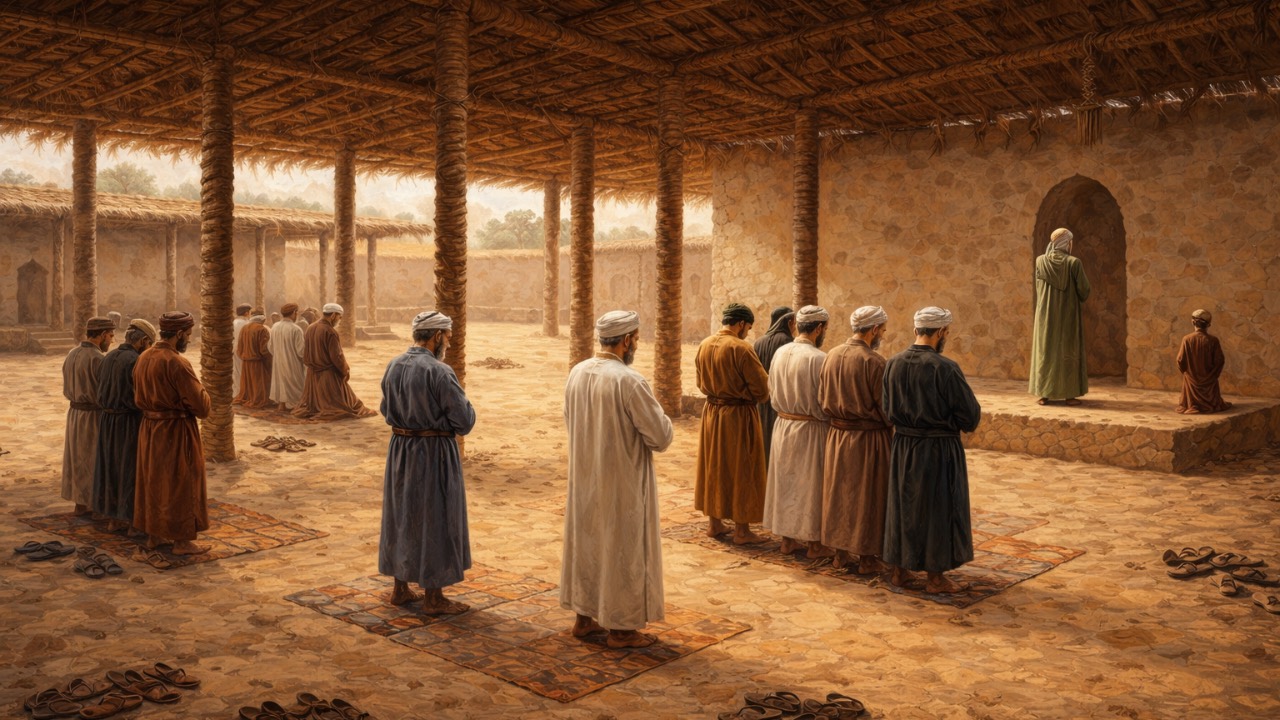
This is why the early stewards of the tradition did not call themselves “theologians.” They were referred to in Arabic as ʿulamāʾ (those of knowledge) and fuqahāʾ (those of deep, critical understanding and intelligence), people who preserved, taught, and applied the covenant. Even when speculative disciplines later arose, they were defensive and marginal as responses to Greek-influenced polemics, not the heart of the tradition. The heart was always living the covenant, not theorising about God. This is why the practical reality of the covenant touched so many lives and its truth conquered darkness and oppression across vast swathes of territory in such a short space of time.
In this covenant, reason and law are not opposites but one and the same. The Proclamation repeatedly ties intellect to justice, loyalty to discipline, and knowledge to practical benefit. The Prophet used to supplicate: “God, I seek refuge with You from knowledge that does not benefit, from a heart that does not humble, from a soul that is never satisfied, and from a supplication that is not answered” (Muslim, al-Nasa'ī). This directly rejects the notion that the mere accumulation of abstract ideas counts as covenantal loyalty. The Proclamation itself warns of this intellectual corruption: “They learned what harmed them and did not benefit them” (Q 2:102) describing how, in the post-exilic period, the Children of Israel chose to abandon the objectives of the covenantal law and pursue nefarious self-interest with powerful knowledge. In sharp contrast, God makes the opposite demand, that knowledge is only real if it cultivates material fairness, disciplines the soul, and upholds the balance of God's order. The point was never to construct systems of doctrine, but to train the soul and reform the world.
Where Western theology assumes a distance between God and the world (between abstract truth and lived practice), the true dīn collapses that distance. The divine will is not something to be contemplated but something to be embodied. What the West calls “religion” here is not a creed but a covenant: a binding moral-political order. It does not ask for assent to metaphysical propositions, but for allegiance to a code that makes human flourishing possible.
To speak of “Islamic theology” is thus already to misname the true Abrahamic tradition. It projects onto it a foreign category, as though the aim of the covenant were to produce doctrines about God rather than to cultivate just and disciplined societies under God that seek optimum outcomes. Modern theology is the product of secular cultures that separated reason from law and mind from life. The Ishmaelite covenant never made such a separation. It presents reason as law and law as reason, rooted in the sovereignty of the Creator and His design of creation.
Where theology talks, the covenant commands. Where theology speculates, the covenant disciplines. Where theology dissects, the covenant integrates. It is not theory about the divine. It is divine reason woven into the fabric of existence.


Responses