
Creative Destruction and Restoring the Ishmaelite Legacy
Creative destruction is a philosophical framework that recognises the necessity of rupture to facilitate higher-order renewal. Joseph Schumpeter popularised the concept in speaking about capitalism whereby progress arises from relentless cycles of innovation and erasure. We see this principle as the convention of God, sunnat’el’Lāh, played out in various events. One example is that of the Israelites in Egypt, where God says:
And We wanted to favour those who were oppressed in the land and make them leaders and inheritors, and to establish them in the land, and to show Pharaoh, Hāmān, and their soldiers what they feared from them. (Quran 28:5–6)
Here, the fall of Pharaoh is an act of historical clearing where divine interruption of tyranny allows something new to emerge. The Israelites’ rise does not come despite Egypt’s collapse, but because of it. God’s intent is described not as reaction but as strategic transformation and the Israelites are repositioned as inheritors and leaders. Pharaoh’s fear of their rise, which motivated his tyranny, becomes the very instrument of his undoing. This is a divine inversion. The elites build to consolidate control but God unbuilds to redistribute power. The act of elevation requires the collapse of the existing order because leadership cannot be granted without displacing the illegitimate rulers.
How many gardens and springs did they leave behind, and farms and noble dwellings, and a life of ease that they enjoyed! Thus it was. And We caused another people to inherit them. (Quran 44:25–28)
The material wealth and cultural systems of Egypt are reassigned through the destruction of the Egyptians. God does not merely erase. He transfers, retools, and re-contextualises power.
We also see this with the communities of Ād and Thamūd in north and south Arabia during the neolithic period. Both were destroyed by God but replaced by people who flourished in those regions. With the storm of Ād came renewed life to the desert (ahqāf), and with it renewed Joktanite (Qahtāni) civilisation.
As a philosophical framework, creative destruction asserts that stagnation is the enemy of vitality. It suggests that outdated forms, whether economic, institutional, or ideological, must be broken down to make room for new paradigms that better respond to the current human condition. This approach views change as teleological, not idolising the past but subjecting it to the test of relevance.
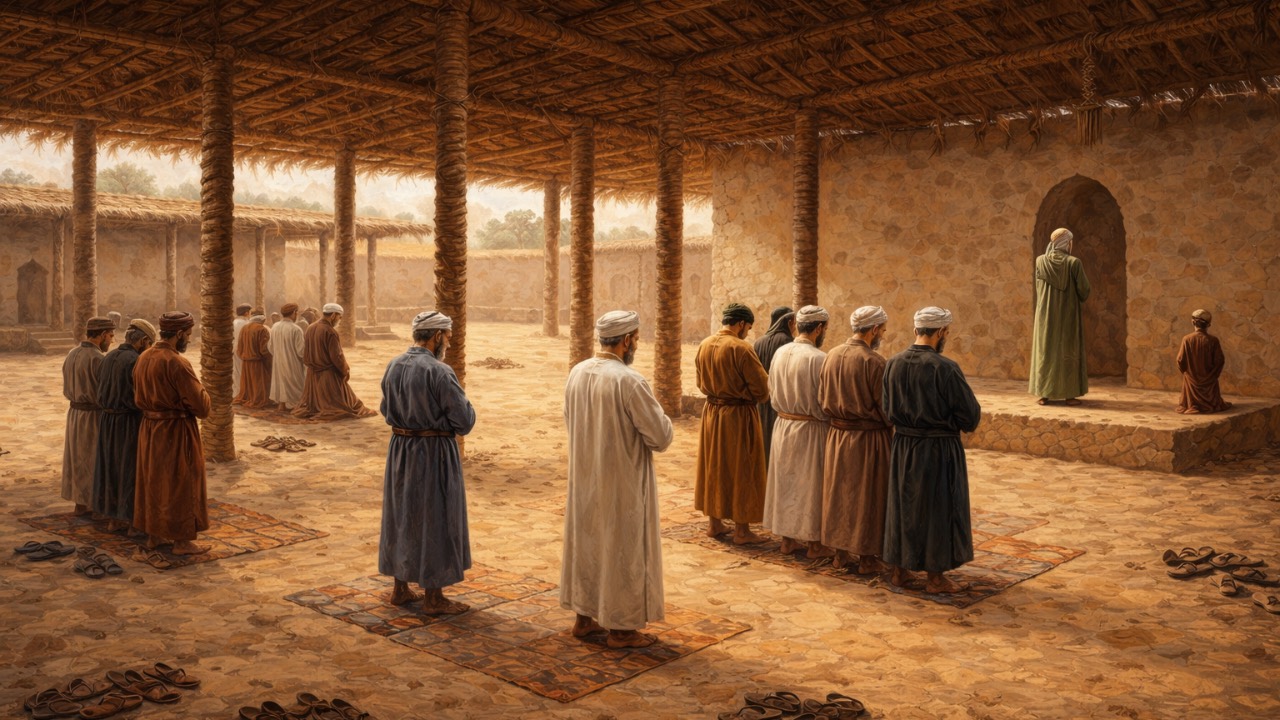
For most Muslims in the West, their religious engagement is primarily driven by cultural preservation than prophetic renewal. Mosques are mostly community centres and fixated on rituals and inherited customs from the postcolonial East rather than spaces of moral and intellectual leadership grounded in the original message of the Quran (Proclamation). This leads to what might be called religious fossilisation which is the maintenance of Islamic form but not Abrahamic function.
In such a context, creative destruction becomes necessary. Not in the violent, iconoclastic sense, but as a process of clearing the ground for a revival of first principles. What needs to be destroyed is not the faith but the accumulated sediment of historical distortions, sectarian ideologies, and political compromises that have obscured the original covenantal message of El’Lāh to Abraham and his descendants.
The final message, when read with theological clarity and historical awareness, is not a new religion but a restoration of the Abrahamic covenant, purified of priestcraft, nationalism, and human interpretations. It positions itself not as a sectarian text but as the final Proclamation of the King to the descendants of Ishmael, and through their custodianship, to all people, recalling the primordial covenant made with Abraham: submission to God as the true sovereign, justice, economic and social integrity, and moral leadership among nations.
Creative destruction here means dismantling the narrative that the “Islam” of the West must resemble postcolonial religion shaped by centuries of empire, legal formalism, and scholastic entrenchment. Instead, it enables a renewed self-conception: individuals genuinely devoted to God as bearers of the Ishmaelite legacy, heirs not of empire, but of prophetic purpose.
The Ishmaelite legacy, if returned to its Quranic and Abrahamic roots, is already a tradition of creative destruction. Abraham himself destroyed the idols of his people and left Mesopotamia. Moses shattered the tablets in the face of apostasy and demanded societal restructuring. Jesus called for an end to Pharisaic entrenchment and rabbinic Judaism. Muhammad dismantled tribal allegiances, Israelite ethno-supremacy and pagan Arabian hegemony to establish an order based on God’s sovereignty and structural fairness. Each of these acts were philosophically disruptive. They involved the destruction of structures that no longer served God’s intended order, and the construction of new forms that did. God explicitly challenges inherited tradition, saying:
But when it is said to them, ‘Follow the message that God has sent down,’ they answer, ‘We follow the ways of our fathers.’ What! Even though their fathers understood nothing and were not guided? (Quran 2:170)
This is creative destruction in scripture, a critique of the uncritical inheritance of tradition in favour of reasoned, revelatory renewal.
In the West, Muslims stand at a unique historical crossroads. Detached from the power structures of Muslim-majority states and living in pluralistic, legally protected societies, they have the freedom (and the responsibility) to undergo a process of creative destruction. This could include abolishing sectarianism and re-aligning around God’s universal ethical message, replacing performative religiosity with lived covenantal responsibility, dismantling postcolonial victimhood narratives and embracing the Quranic view of being witnesses to mankind (2:143), not perpetual victims with a minority complex, and discarding clerical authoritarianism and cultivating leadership that speaks aptitude, wisdom, progress and overachievement.
This is not reform for the sake of Western or Eastern assimilation, but renewal for the sake of fidelity to Abraham’s tradition.
Philosophically, creative destruction enables the possibility of becoming again. It reminds the faithful that sometimes the greatest act of loyalty to the truth is the courage to remove what no longer serves it. For the tradition of Abraham, as led by the righteous Ishmaelites and sealed in the final Proclamation, this means reasserting the primacy of God’s sovereignty, law, and justice, above cultural comfort, ethnic or national loyalty, or historical inertia. To benefit "Islam in the West" is not to preserve it as it is, but to revive the Abrahamic covenant as it was meant to be and that means, at times, wielding the fire as well as the lamp.


Responses